Clues in Census Records, 1900-1940 Summary
Experienced genealogical researchers use clues found in one record to find other records about the same individual.
This page describes some of the clues for further research found in census records.
Where to Find Census Records Online:
Listings:
Free:
Family Search.Org
Heritage Quest- Available through libraries/Texshare
Subscription:
Ancestry.com
MyHeritage.Com
Genealogybank.com https://www.genealogybank.com/explore/census/all
US GENEWEB Transcription Projects:
Free Forms:
Family Search Wiki https://www.familysearch.org/wiki/en/United_States_Census_Forms
Census Headings 1790-1860 https://www.familysearch.org/wiki/en/img_auth.php/0/0e/US_Census_Headings_1790-1860.pdf
Census Headings 1870-1930 https://www.familysearch.org/wiki/en/img_auth.php/b/b8/US_Census_Headings_1870-1930.pdf
Census Headings 1940 https://www.familysearch.org/wiki/en/1940_Census_United_States_%E2%80%93_Census_Form_Headings
Dollarhide Census Forms https://www.heritagequestonline.com/hqoweb/library/help/censusbook/Section%205.pdf
National Archives Census and Other Forms https://www.archives.gov/research/genealogy/charts-forms
Census Forms at Rootsweb.com https://freepages.rootsweb.com/~craycroftfamily/genealogy/Research_files/U_S_Census_Returns.html
Census Analysis Forms
http://www.svcgg.org/documents/census_analysis_forms.pdf
Individual Census Worksheet-To keep track of your research for an individual https://stlgs.org/media/freeforms/r137-census-wksheet-2015.pdf
Census and Other Forms at Midcontinent Library, St Louis, MO https://www.mymcpl.org/genealogy/resources/family-history-forms
Census Dates:
1 June 1900
15 April 1910
1 January 1920
1 April 1930
1 April 1940
1 April 1950
Soundex
Family search Wiki about Soundex https://www.familysearch.org/wiki/en/Soundex
Soundex Code Generator https://www.gjenvick.com/Students/SoundexCodeGenerator.html
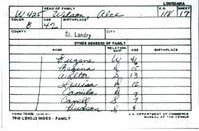
Name
- Each Census 1900-1940 gives the name of each person in a household
Address
- Each Census 1900-1940 gives the street and house number of each household
- This helps the researcher be able to identify an ancestor or person of interest and be able to help distinguish this person from another of a similar or like name.
- The Censuses were taken every 10 years. City Directories or other records can fill in gaps for the between censuses.
Relationship to Head of Household
- Each Census 1900-1940 gives the relationship of each person in a household to the Head of Household
Informant/Respondent
- 1940 Census has symbol indicating who gave household information
Where did this person live in 1935?
Same Place? OR City, State, Country?
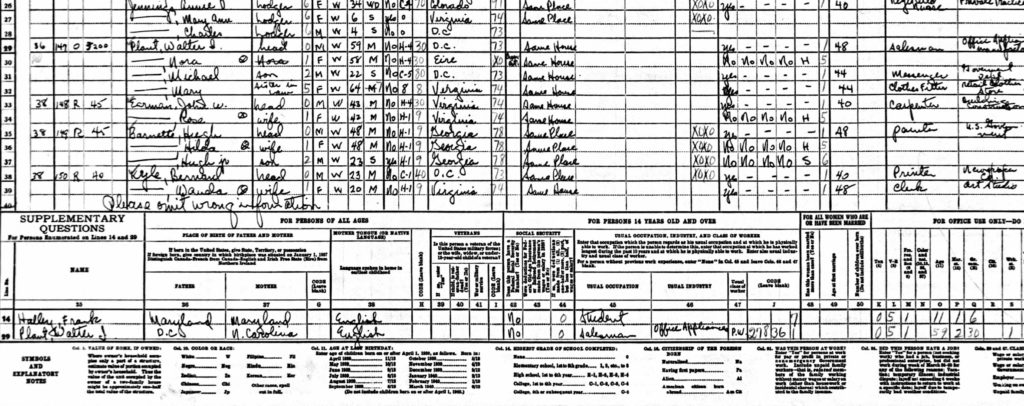
Residence in 1935
Where did this person live in 1935?
Same Place ? OR- City, State, Country
Date of birth
- The 1900 census (column 7) indicates the person’s month and year of birth;
- 1900-1940 censuses indicate the person’s age as of the census date.
- While the person’s age is not an exact date of birth, it at least provides a “ballpark” figure useful
- (1) for tracking the person from one census to the next, especially if other people have the same name, and
- (2) for locating the person in any existing vital records.
Place of birth
- The 1900-1940 censuses indicate the person’s state or country of birth, which helps narrow the geographic scope of search for the specific town of birth.
- The 1940 Census asks Place of birth and if that place was a foreign country what was the name of the country based on a 1937 map . The 1937 map was used as the borders of countries in Europe as well as other countries in the world were a steady flux of change of border as well as name.
Date of marriage
- The 1900 census (column 10) and 1910 census (column 9) indicate the number of years of marriage in their current marriage for each married person.
Marital Status
States whether Married, Divorced, Widowed, Single
Number of children
- The 1900 census (column 11) and 1910 census (column 10) indicate how many children were born to each woman.
- The 1900 census (column 12) and 1910 census (column 11) indicate how many of those children were still living.
- These clues can help determine whether the researcher has identified all children in a given family, and whether any were deceased when either census was taken.
Occupation-Industry-Work History
- Each Census 1900-1940 asks for occupation, trade or industry
- Each Census 1910-1940 ask questions about work, wages and ability to work
Immigration
- The 1900 census (column 16), 1910 census (column 15), 1920 census (column 13), and 1930 census (column 22) each indicate the person’s year of immigration to the United States.
- This information should help in locating a ship passenger arrival list.
Naturalization
- The 1900 census (column 18), the 1910 census (column 16), and 1920 census (column 14), and 1930 census (column 23) indicate the person’s naturalization status. The answers are:
- “Al” for alien,
- “PA” for “first papers,” and
- “NA” for naturalized.
- The 1920 census (column 15) indicates the year in which the person was naturalized.
These clues may lead in information on a person’s naturalization
Foreign-born parents
- 1900 census (columns 14-15), 1910 census (columns 13-4),
- 1920 census (columns 21 & 23), and
- 1930 census (columns 19-20)
- indicate the person’s parents’ birthplaces.
- 1940 Census asked two people on each page (Person number 14 and 29) the place of birth of each parent. The parents may or may not have been born in a foreign country
Military Service
- Service in Union or Confederate Army or Navy
- The 1910 census (column 30) indicates whether the person was a “survivor of the Union or Confederate Army or Navy.”
- The answers are:
- “UA” for Union Army
- “UN” for Union Navy
- “CA” for Confederate Army
- “CN” for Confederate Navy.
- These clues lead to military service and pension records
- A word of caution:
- On the 1910 census, columns 30-32 are often “overwritten” with numbers like 2-1-0-0 or 6-9-0-0.
- These numbers are not the answers for columns 30-32, but were data summaries used by Census Bureau tabulators in Washington, DC, to compile statistical data.
- The 1930 census (column 31) indicates Civil War veterans with the abbreviation “CW.”
- Does not ask Confederate or Union
- Military Service, 1898-1918, in Major Wars
- The 1930 census (column 31) indicates military service in other wars with
- “Sp” for Spanish-American War
- “Phil” for Philippine Insurrection,
- “Box” for Boxer Rebellion
- “Mex” for Mexican Expedition
- “WW” for World War I.
Literacy
The 1910 Census asks if a person can read or write Also asks if the person is able to speak English or if not, which language is spoken
1920 Census asks place of birth of the person being enumerated and that of each parent. In addition it asks if the mother tongue of the person being enumerated and each of that person’s parents. It also asks if the person is able to speak English
1930 Censusasks of anyone foreign born the language they spoke at home before coming to the United States. It also asks if the person can speak English
Real property
- The 1900 census (column 25), 1910 census (column 26), 1920 census (column 7), and 1930 census (column 7) indicate whether the person owned (“O”) or rented (“R”) the home or farm.
- The 1900 census (column 26), 1910 census (column 27), and 1920 census (column 8) indicate whether home and farm owners owned their property with a mortgage (“M”) or free of mortgage (“F”).
- The 1930 census (column 8) and 1940 census (columns 4 and 5) indicate the value of home, if owned, or the monthly rental, if rented. There are also other housing related questions.
These clues should lead researchers to the county recorder’s office or equivalent agency for deeds, mortgages, and property tax records.
Blind/Deaf
- 1910 Census (Column 31 and 32) asks if a person is blind in both eyes, or deaf and dumb
Business Schedules, 1935
The 1935 Census of Business was the largest and most inclusive inventory of business establishments undertaken by the Bureau of the Census up to that time. The Census was designed to provide a picture of essential items of business information concerning most lines of business activity in the United States.
Fifteen categories of businesses were originally surveyed. Upon completion of tabulations and reports, the Department of Commerce, under authority granted by Congress, disposed of the schedules relating to construction; distribution of manufacturers’ sales; and hotels, retail trade, and service and amusement. See the following Congressional reports for more information:
- Construction: 75th Cong., 1st sess., H. Rep. No. 1538, July 21, 1937, and 78th Cong., 1st sess., H. Rep. No. 555, June 16, 1943
- Manufacturers’ sales: 81st Cong., 2d sess., H. Rep. No. 3208, Dec. 19, 1950
- Service and amusement: 78th Cong., 1st sess., H. Rep. No. 555, June 16, 1943)
The schedules relating to advertising agencies, banks, bus transportation, financial institutions, insurance and real estate, miscellaneous, motor trucking for hire, public warehousing, and radio broadcasting were retained and transferred to the custody of the National Archives in 1941 and 1946.
In 1953, in order to dispose of the paper schedules, the National Archives transferred to microfilm the following categories of schedules: advertising agencies, banks and other financial institutions, miscellaneous enterprises, motor trucking for hire, public warehousing, and radio broadcasting. Disposal of the original paper schedules after microfilming was authorized by Congress (83d Cong., 1st Sess. H. Rept. 573, June 17, 1953).
The remaining schedules, relating to bus transportation, insurance and real estate, service and amusement, and wholesale trade were retained in paper form because “resources required for extensive rearrangement prior to microfilming were not available.”
Available 1935 Census of Business Microfilm Publications
Roll lists are available for the six 1935 Census of Business microfilm publications:
- M1797, Advertising Agencies
- M2066, Banking and Financial Institutions
- M2067, Miscellaneous Enterprises
- M2068, Motor Trucking for Hire
- M2069, Public Warehousing
- M2070, Radio Broadcasting Stations
Conclusion
Researchers who use these and other clues in census records will be more
successful–and thorough–in their genealogical research.