State Censuses
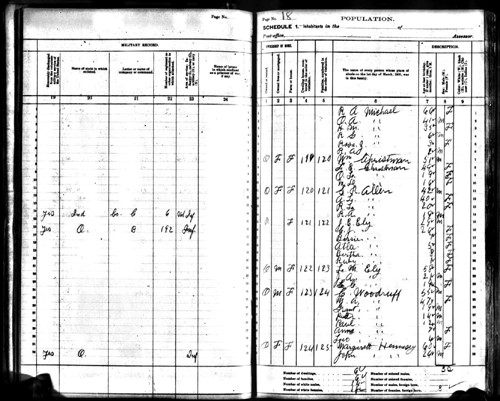
The Kansas State Board of Agriculture conducted a census
of the state in 1905 (questionnaire above). The census
collected the names of all members of household and their
age, sex, race or color, and state or country of birth. The
census also collected information about members’ state or
country of origin and military service.
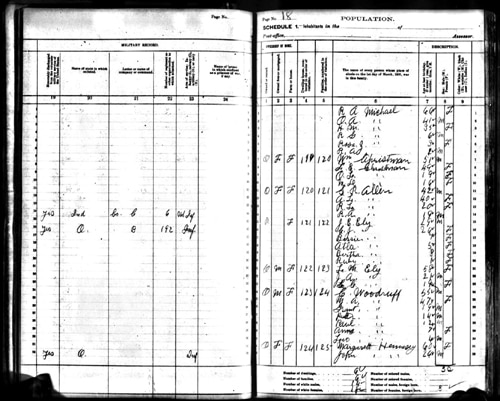
State censuses can be as important as the federal census to genealogists but, because they were taken randomly, remain a much under-utilized resource in American genealogy.
State censuses often can serve as substitutes for some of the missing federal census records – most notably the 1790, 1800, 1810, and 1890 censuses.
Many state censuses also asked different questions than the federal census, thus recording information that cannot be found elsewhere in the federal schedules.
While not all states took their own censuses, and some have not survived, state and local census records can be found in many locations.
Most states which took censuses usually did so every 10 years, in years ending in “5” (1855, 1865, etc.) to complement the federal census.
These state census records are most often found at the state archives or state library.
Many are also digitized through Family Search and it’s affiliate online commercial genealogy databases.
A list of State Censuses as compiled by Ann S. Lainhart in her book State Censuses is available at: https://www.census.gov/history/www/genealogy/other_resources/state_censuses.html
Federal Non-Population Schedules
Introduction
Non-population census records can add “flesh” to the bones of ancestors and provide information about the communities in which they lived.
Slave Schedules are available for Census years 1850 and 1860. Agriculture, mortality, and social statistics schedules are available for the census years of 1850, 1860, 1870, and 1880. Manufacturing schedules are available for 1820, 1850, 1860, 1870, and 1880. These records are arranged by state, then by county, and then by political subdivision (township, city, etc.).
Most of the extant non-population schedules are available on microfilm and are now beginning to be included in the listings of online database companies such as Family Search and it’s affiliates.
Because an enumerator completed the Free Population and the Non-Populations Schedules at the same time in his enumeration canvas try to follow his path to see if the Non-Population entries for your ancestor is present.
Schedules of business are available for 1935 for the following industries: advertising agencies, banking and financial institutions, miscellaneous enterprises, motor trucking for hire, public warehousing, and radio broadcasting stations.
Slave Schedules 1850 and 1860 for all states having slaves
Agriculture, mortality, and social statistics schedules are available for the census years of 1850, 1860, 1870, and 1880.
Manufacturing schedules are available for 1820, 1850, 1860, 1870, and 1880
They are arranged by state, then by county, and then by political subdivision (township, city, etc.)
These schedules can add “flesh” to the bones of ancestors and provide information about the communities in which they lived.
For a list of Special Census Schedules 1850-1880
Visit: https://wiki.rootsweb.com/wiki/index.php/Non-Population_Schedules_and_Special_Censuses
List of Non-population Schedules at Family Search: https://www.familysearch.org/wiki/en/United_States_Federal_Non-Population_Census_Schedules
Included in the Non-Population Schedules were:
Schedule No. 2- Slave Inhabitants
Slaves were listed by owner, not individually. There were two columns whereby the enumerator listed slaves chronologically, usually by gender or chronologically by age
- Name of owner
- Number of slave
Each owner’s slave was numbered rather than by name. Numbering restarted with each new owner - Age
- Sex
- Color- B for Black, M for Mulatto
- In addition, there were notations as the owner if a slave had escaped and was still not captured
- There was another notation in the same row as the owner, the number of slaves freed from bondage in the past year
- Is the slave “deaf and dumb, blind, insane, or idiotic?”
- There was also a notation as the owner of the number of slave cabins
Mortality Schedules
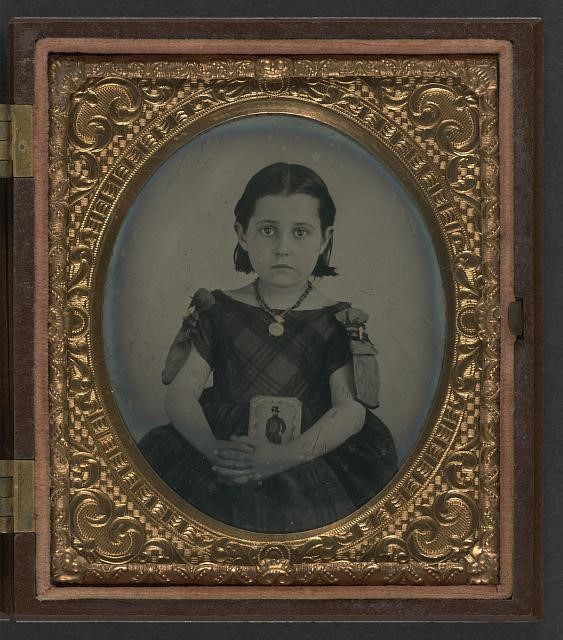
An unidentified girl wearing a mourning dress
holds a picture of her father.
Photo courtesy of the Library of Congress
In 1850, 1860, 1870, 1880, and 1885 (applicable state censuses), the census included inquiries about persons who had died in the year immediately preceding the enumeration (Figure 2). In general, the questions covered the following topics:
- Name
- Age at last birthday
- Sex
- Race
- Marital status
- Profession, occupation, or trade
- State, territory, or country of birth of person and parents
- Length of residence in county
- Month in which person died
- Disease or cause of death
- Place where disease contracted (if not at place of death)
- Name of attending physician
A listing of available mortality schedules, by state and year, is available at https://www.census.gov/history/pdf/mortality.pdf
Agricultural Schedules
Agricultural schedules of 1850, 1860, and 1870 provide the following information for each farm:
- Name of owner or manager
- Number of improved and unimproved acres
- Number of livestock owned by farmer (broken down by breed)
- Amount of agricultural goods produced during the preceding year (broken down by crop)
- Cash value of the farm, farming machinery, livestock, animals slaughtered during the past year, and “homemade manufactures”
The 1880 schedules provide additional details, such as the amount of acreage used for each kind of crop, the number of poultry, and the number of eggs produced.
1850 Agricultural Schedule Form at NARA https://www.archives.gov/files/research/genealogy/charts-forms/1850-agriculture.pdf
Link to all Agricultural Schedules 1850-1880 at NAR https://www.familysearch.org/wiki/en/Rural_Records_of_the_Southern_United_States
Clue:
When a person was listed with the occupation of “Farmer” always check to see if he is listed in this schedule
Exclusions: Not every farm was included in these schedules. In 1850, for example, small farms that produced less than $100 worth of products annually were not included. By 1870, farms of less than three acres or farms that produced less than $500 worth of products were not included.
Manufacturing Schedules
The quantity and quality of data in manufacturing schedules varies by census year.
1810
On May 1, 1810, the Congress passed an Act directing that “an account of the several manufacturing establishments and and manufactures” be made. However, neither Congress nor the Secretary of the Treasury provided U.S. Marshals with specific instructions about the information that they should collected. As a result, the quality and quantity of the information collected about manufactures varied greatly.
Information is usually included as annotations on the population census schedules found in the descriptive pamphlet for National Archives Microfilm Publication M252, Third Census of the United States, 1810.
1820 & 1850–1880
Manufacturing schedules in 1820, 1850, and 1860 provide the following information for each farm:
- Name of the manufacturer
- Type of business or product
- Amount of capital invested
- Quantities, kinds, and value of raw materials used
- Quantities and value of product produced annually
- Kind of power or machinery used
- Number of men and women employed
- Average monthly cost of male and female labor
The amount of detail reported in these schedules increased in 1870 and again in 1880. In 1880, supplemental schedules were also used for specific industries, such as boot and shoemaking, lumber and saw mills, and flour and grist mills.
Exclusions: Small manufacturing operations that produced less than $500 worth of goods were not included on any of the schedules.
Social Statistics Schedules
Social statistics schedules seldom give names of people. Instead, it provides statistical information about communities. Compare information in this schedule with what you know of your ancestor or ancestral family to help you gain a better perspective of their life/lifestyle
In 1850 through 1870, these schedules indicate the following information for each political subdivision:
- Value of real estate
- Annual taxes
- Number of schools, teachers, and pupils
- Number and type of libraries and number of volumes they have
- Name, type, and circulation of newspapers
- Types of church denominations, number of people each church can seat, and value of their property
- Number of native and foreign-born paupers and cost of supporting them
- Number of native and foreign-born criminals convicted and in prison
- Average wages paid to farm hands, day laborers, carpenters, and female domestics
Note that these schedules only provide statistical data, not information about specific individuals.
In contrast, the 1880 schedules of delinquent, defective, and dependent classes list deaf, dumb, blind, and criminal persons by name and provide information about them on an individual basis.
This type of health information can aid present day people trace hereditary health issues they may experience today
https://www.archives.gov/research/census/nonpopulation#agricultural
Nonpopulation Census Schedules by State, 1820-1930
Additional Research
For more detailed information about nonpopulation census forms and instructions before 1900, consult:
- Caroll D. Wright, History and Growth of the United States Census (Washington, DC: Government Printing Office, 1900; reprinted by Johnson Reprint Corporation, New York, 1966).
- Claire Prechtel-Kluskens, “The Nonpopulation Census Schedules,” The Record, Vol. 2, No. 1, pp. 9 & 25 (Sept. 1995).
Where to Find These Records:
- Some nonpopulation census schedules are digitized and available online. See the list of Records Digitized by Our Digitization Partners for the sites that host the images.
- Microfilmed records can also be viewed at the National Archives Building in Washington, DC, and at some regional NARA facilities. Search the Microfilm Catalog to find the NARA facilities that house particular microfilm publications.
- If the nonpopulation census schedules in which you are interested are not available from NARA, then you should contact the state archives or equivalent agency.
Conclusion
Researchers who use these and other clues in census records combined with one another will be more successful–and thorough–in their genealogical research.