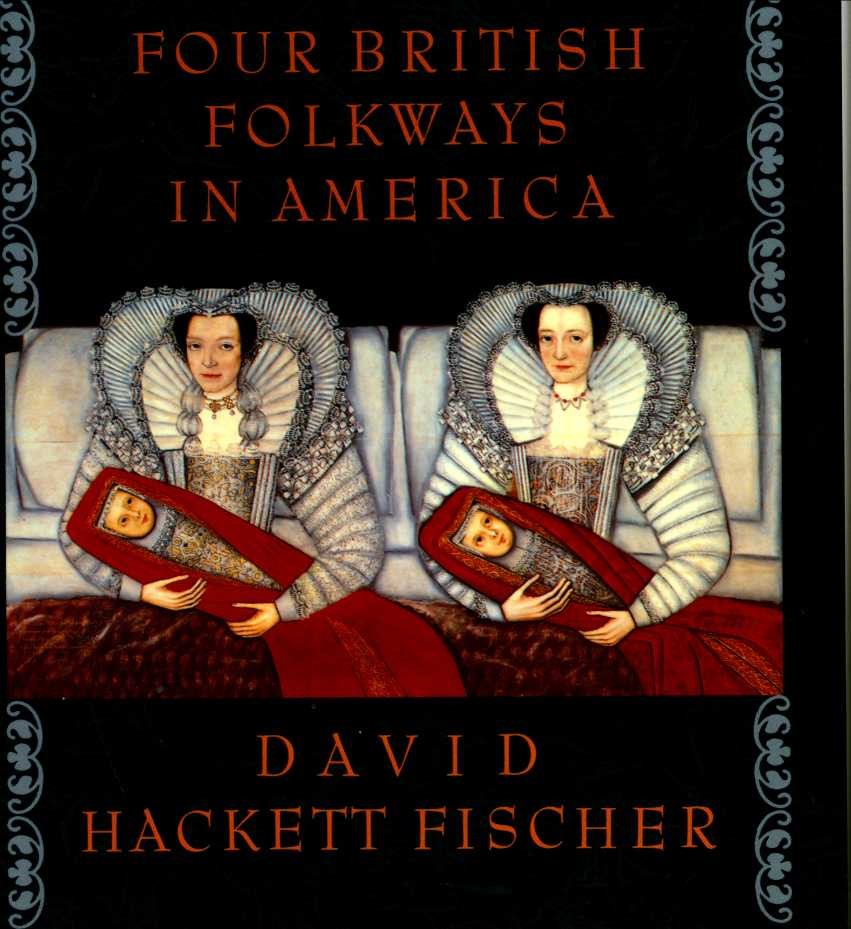
ALBION’S SEED
By David Hackett Fischer
Oxford University Press, New York and London
Copyright 1989
CONTENTS:
PREFACE
An Idea of Cultural History, vii
ILLUSTRATIONS
Drawings, Maps and Tables, xv
INTRODUCTION
The Determinants of a Voluntary Society, 3
EAST ANGLIA TO MASSACHUSETTS:
The Exodus of the English Puritans, 1629—41, 13
THE SOUTH OF ENGLAND TO VIRGINIA: Distressed Cavaliers and Indentured Servants, 1642-75, 207
NORTH MIDLANDS TO THE DELAWARE:
The Friends’ Migration, 1675-1725, 419
BORDERLANDS TO THE BACKCOUNTRY:
The Flight from North Britain, 1717-1775, 605
CONCLUSION
Four British Folkways in American History:
The Origin and Persistence of Regional Cultures in the United States, 783
Acknowledgments, 899 Abbreviations, 903 Sources for Maps, 907 Index, 911
British Origins of American Colonists, 1629-1775
By William Dollarhide
Published by AGLL Genealogical Services Bountiful, Utah 1997

Contents
Preface………………………………………………………………………………………………..
Finding the Home of a British Emigrant………………………………………………… 1
The Needle in a Haystack……………………………………………………………………. 1
British Place-Finding Sources………………………………………………………………. 3
East Anglian Puritans to New England, 1629-1640………………………………… 7
The Origins of the Puritans………………………………………………………………….. 9
Transplanted Cultures……………………………………………………………………….. 12
Cavaliers and their Servants to the Chesapeake, 1641-1675…………………… 15
Origins of Virginia and Maryland Immigrants……………………………………… 18
Transplanted Cultures……………………………………………………………………….. 20
North Midland Quakers to the Delaware Valley, 1675-1725 …………………. 23
William Penn……………………………………………………………………………………. 24
Quaker Folkways……………………………………………………………………………. 25
Origins of the English Quakers…………………………………………………………… 26
The Friendly Germans……………………………………………………………………….. 29
Quaker Marriages……………………………………………………………………………… 30
Stages of Quaker Beliefs…………………………………………………………………… 31
British and Scottish Borderers to America, 1717-1775……………………………… 33
A Brief History of the Borderers’ Move to Northern Ireland………………….. 34
Origins of the Borderers……………………………………………………………………. 34
Borderlands Culture………………………………………………………………………….. 36
700 Years of Violence in the Borderlands……………………………………………. 37
Banishment of the Borderers……………………………………………………………… 38
Northern Ireland by 1715………………………………………………………………….. 39
Borderers to America………………………………………………………………………… 39
Borderer Settlements in America………………………………………………………… 42
Sources for Genealogical Research in Great Britain…………………………….. 47
Index………………………………………………………………………………………………….. 61
Maps
Atlantic Colonies, 1607-1626……………………………………………………………………………… 2
New England Settlements, 1620-1648………………………………………………………………… 8
County Origins of the Puritans………………………………………………………………………….. H
Chesapeake Settlements, 1641-1675…………………………………………………………………. 16
County Origins of the Virginia and Maryland Immigrants…………………………… 19
Quaker Settlements in America, 1675-1715…………………………………………………….. 27
County Origins of the Quakers…………………………………………………………………………. 28
British-Scottish Borderlands and Northern Ireland……………………………………….. 35
Scotch-Irish Settlements in America, 1790 ……………………………………………………… 43
Preface
This book identifies the county origins of the main migration groups from the British Isles to the American colonies before the Revolutionary War. Four distinct migration groups are identified:
- The East Anglian Puritans to New England, 1629-1640.
- The West Country Cavaliers and their Servants to the Chesapeake, 1641-1675.
- The North Midland Quakers to the Delaware Valley, 1675-1715.
- The British and Scottish borderers (the so-called “Scotch-Irish”) to the backwoods of the American colonies, 1717-1775.
These groups were not the very first colonies, but the ones that came after the first experiments in colonizing British North America. Clearly, these four waves of immigrants came in greater numbers and had greater success in establishing themselves in the New World. If an American today has a British ancestor who arrived during the colonial period, there is a very high chance that he was part of one of these four waves of migrations.
The goal of this book is to provide a genealogical researcher with guidelines that will aid in locating a British ancestral home. The guidelines assume that a researcher has no specific knowledge of the origins of his British immigrants. Much of the information
about the origins of the four groups is based on estimated percentages, and necessarily, some generalizations. For example, the 21,000 Puritans who came to America during the Great Migration of 1629-1640 originated from nearly every county in England; but about half of them came from just three counties. In fact, a large percentage of each of the four groups came from specific cluster regions of the British Isles. So, even with such generalizations about their origins, it may be possible to have a starting point in British research with higher odds for success than taking a shotgun approach to research in the British Isles.
All four migration groups left their homes in the British Isles during a specific span of years, from an eleven year period for the Puritans, to a fifty-seven year span for the Scotch-Irish migration. Each group was a minority in Britain, either in their politics or their religious beliefs. Their history is one of social, political, and religious turmoil; and they believed their lives could be improved by moving to America. Most of the groups settled in specific cluster areas of colonial America. Therefore, if a researcher knows the first place an ancestor lived in America within an approximate time period, that information should provide a strong pointer to his British home within a limited number of counties. The maps in the book identify the locations where each group lived in Great Britain, as well as the places they settled in America.
Finding the Home of a British Emigrant
A Needle in a Haystack
There is a scientific method that can be used to find a needle in a haystack. First, see if you can determine where the needle most likely went into the haystack. With this information, you should have a starting point. Next, carefully remove the areas of the stack of hay the needle probably did not touch. The task becomes one of reducing the stack of hay to the smallest size possible. Now begin sifting and removing the pieces of straw one-by-one to find the needle. The smaller the stack of hay can be reduced in size, the better your chances will be to find the needle.
So, before jumping into a large haystack or making random searches in English county records, let’s start by understanding where our ancestors from England may have lived just before their journey to America. In other words, let’s reduce the size of the haystack. There were very specific groups that started the first colonies in America. And, it can be determined that certain counties of England supplied large groups of immigrants to America. By identifying the places in England where these groups lived, perhaps we can narrow down the number of counties where you need to search for evidence of your ancestor in England. To accomplish this process, you must first know something about your immigrant ancestor in America. If you are able to determine where he came to live first and the approximate time period in which he arrived, then you have a good starting point.
Your British ancestor was probably not from the first permanent English colony in America, the Virginia Company, which began in Jamestown in 1607. Like most of the earliest colonies, the Jamestown settlement was made up mostly of men who died young and unmarried. For example, there are almost no descendants of the founders of the Jamestown colony in America. Of the 104 original settlers of Jamestown, only one is known to have had surviving descendants in America. His name was Robert Beheath-‘ land. The rest of the descendants of these men were born in England and remained there, although later generations may have migrated to America.
After Jamestown, the most famous British settlement was New Plymouth, established in 1620 in Massachusetts and consisted of Pilgrims seeking religious freedom. The genealogies available to researchers outlining the descendants of the Mayflower and subsequent Pilgrim arrivals are well known and documented. If you can connect to an ancestor as one of the Pilgrims of New Plymouth Colony, your work will have been done for you already. But the Pilgrims were incorporated into the larger and more successful Massachusetts Bay Colony after only a few decades. Later generations of the original Pilgrims were overshadowed by the children of the Puritans, the dominant group of settlers in early Massachusetts.
After the early 17th Century experiments in colonizing North America, larger and better organized groups of settlers began arriving in the New World. The first of these large groups was the migration of Puritans to New England beginning in 1629. Since the numbers of settlers increased, the work of locating an ancestral home in the Britain Isles for an emigrant increases in difficulty. Without family stories or written sources that tell you the place where your ancestors lived, the work to locate an ancestral home in Britain may actually feel like trying to find a needle in a haystack.
Therefore, if we are to be successful in locating British records that reveal the names of our early immigrant ancestors, we need to employ the same techniques we use in finding the homes of our American ancestors. We need to first find the jurisdiction in which they lived. We know, for example, that locating the right county of residence in America is the key to finding records for an ancestor who lived there. With that knowledge, one can begin a systematic search of published county records that may reveal evidence of a family name.
American genealogical research is often keyed to the land a person owned. Land ownership in America before 1850 was as high as 90 percent of all adult white males. As a result, U.S. land records are nearly universal as finding tools. And, since real, estate transactions are recorded at the county level in the U.S. for most states, indexes to deeds provide a excellent historic overview of the residents of a county in virtually every state. It is estimated that family researchers have a 90% chance of success for locating a place of residence for a person in the U.S. just by reading deed indexes, county-by-county, within any state. Another advantage to American research is the early Federal censuses taken since 1790 which frequently list the names of immigrants or their descendants. A census name index or a deed index acts as a valuable place-finding tool for further research in America.
British Place-finding Sources
Unlike American sources, land records as an effective tool for English research are mostly limited to an elite society of landlords. And, since nationwide census records in England which list names of people did not begin until 1841, they do not provide the names of emigrants to America during the colonial period. Locating the home of a person in 17th Century British records requires other general name lists that may help locate the county and then a parish within a county where that person lived. An English parish is the jurisdiction where* vital statistics such as births, baptisms, marriages, deaths, and burials are recorded. If a name can be connected to just a few English counties, the job of searching parish records within each county becomes a task that is more easily accomplished.
There are some national sources for surnames in the British Isles. A few of them are identified below. Without knowing a specific location for a particular surname in Britain, for example, a search of one of these large name lists may reveal a location where a particular surname occurs. If nothing else, the name lists may show where a particular surname is most commonly found and perhaps narrow down the number of counties that need to’ be searched in more detail.
To use these name lists effectively, a researcher should have more than one name to help refine the task of finding a residence for a person. For example, if a researcher knows the surname of an Englishman and the maiden name of his wife, the work gets easier because you now have two surnames to link to a particular place. Additionally, researchers should find allied names, such as an ancestor’s neighbors in America who, due to the fact that they lived near your ancestor, may have traveled with him from the same place in England. Adding more names for the search in these place-finding sources is a method of narrowing down the number of places where a certain group of surnames occur.
So, the first task in British research is to find a county where your ancestor’s surname appears. Then, a search of each parish within that county is necessary. It is in the parish records where we can find confirmatiori of a person’s residence in Great Britain. Fortunately, many of the parish records of the British Isles have been microfilmed and are available for research in this country through the Family History Library of The Church of Jesus Christ of Latter-day Saints and its many branches across the country. In addition, many of the parish registers available on microform are available at the Library of Congress in Washington, D.C. These can be obtained on inter-library loan at over 6,000 public libraries across the nation.
Here are some general place-finding sources for the British Isles. These are large name lists which can be used to locate a place in the British Isles where a certain surname may occur;
- Telephone Books and Directories
- A telephone book is a source for locating a name in a certain place. Even a current directory is valuable, which can confirm if a certain name still occurs in that place today. This is because descendants of your British families with the same surnames may still live in the same village, parish, or county. A selection of British phone books are available at many libraries in this country. Privately published nationwide phone directories on CD-ROM are also available for English places. (One is called Brit-phone.) These are also found in larger U.S. libraries.
- International Genealogical Index
- This is an outstanding tool that can be used in locating a British home. The International Genealogical Index (Id) is available at the Family History Library in Salt Lake City and at more than 2,000 Family History Centers across the U.S. The IGI is a computerized index to surnames. It is divided by country. The British section contains over 30 million entries. Most of the entries were extracted from British parish records, especially baptisms and marriages. The IGI can be used to find a surname in a certain place in Britain, because it generally gives the precise county or parish location in Britain where a particular name was found. Even without knowing the relationship of a person listed in the IGI, it is useful to conduct this type of search. It may reduce the number of counties where a particular name occurs. To locate a Family History Center (FHC), use a phone directory to locate a Church of Jesus Christ of Latter-day Saints Chapel. Call and ask where the nearest FHC is located in your area. They are all open to the general public.
- Genealogical Research Directory
- (GRD). This is an international directory in which genealogical researchers from around the world advertise the names of people they want to find. The directory lists ancestral names in alphabetical order, along with the names and addressess of the persons who submittted the names. The GRD is an annual publication with at least 150,000 name entries per year. Since 1980, the GRD has published over two million name entries. The GRD becomes a place-finding tool. If a particular person back in time is listed in the GRD, the place of that person’s residence, birth, marriage, or death is also listed. Even if the name is not recognized as an ancestor, the connection of the name to a place, such as a parish or county of England, is of great value. The GRD is published in Australia and has submitters from countries all over the world. The current and back issues of the GRD can be found in larger U.S. libraries with geneailogy sections. The American representative is Mrs. Jan Jennings, 3324 Crail Way, Glendale, CA 91206-1107. (E-mail: jxpfo4b@prodigy.com). A recent compilation of the past five years of GRD entries was made available as a single CD-ROM disk, containing over 500,- 000 name entries listed in alphabetical order.
- British Isles Genealogical Register
- This is a compilation of names of interest to British genealogists published by the Federation of Family History Societies of England. Created in 1994, it lists over 300,000 names submitted by British genealogists over the past twenty years. Many of the names came from an earlier publication of the Society of Genealogists called the National Genealogical Register which was published annually for several years. It is now a microfilm publication and is available at the Family History Library in Salt Lake City and through inter-library loan at over 2,000 local Family History Centers. Since all entries are related to British names and places, it can be a useful tool in locating a place in the British Isles where a particular surname occurs. It may also connect an American researcher with a genealogist in the British Isles following the same surname.
- Boyd’s Marriage Index
- This index to English marriage records was compiled by Percival Boyd, one of England’s most acclaimed genealogists. It contains over seven million name entries taken from parish registers, bishops’ transcripts, and marriage licenses. The index does not cover every county of England but is virtually complete for all marriages which occurred between 1538 and 1837 in all parishes within the city of London and the counties of Cambridgeshire, Cornwall, Cumberland, Derbyshire, Devonshire, Durham, Essex, Gloucestershire, Lancashire, Middlesex, Norfolk, Northumberland, Shropshire, Somerset, Suffolk, and Yorkshire. The printed county-wide volumes of Boyd’s Index are available in this country at the Family History Library in Salt Lake City. Microfilm versions are available on interlibrary loan at the many local Family History Centers across the U.S.
- Family Origin Name Survey
- This is a two-part computerized genealogical research database. The first part contains abstracts of all known surviving British record material from the period before 1600, with the exception of parish baptisms and marriages, 1538-1600 (which should eventually be covered by the International Genealogical Index). The Pre -1600 Record Sources include administrations, ancient deeds, assize rolls, bishops’ registers, cartularies, charter rolls, courts baron, courts leet, curia regis rolls, ecclesiastical courts, eyre, feet of fines, fine rolls, heraldic visitations, hundred rolls, inquisitions, lay subsidies, liberate rolls, pipe rolls, poll taxes, proofs of age, star chamber, state papers, treaty rolls, and wills.
- Non-Register Archives 1600-1858
- contains an archives of will abstracts, will lists, and other name lists such as poll books, land tax assessments, muster rolls, etc., for the period 1600 to 1858. In both databases, the information consists of abstracts of the original records, along with a name index to any person mentioned in any way. The two databanks were compiled from existing computer databases as well as manual indexes which have been computerized and incorporated into the system. They were originated as research sources specific to the study of the origins and distribution of surname groups in England from 1086 to 1858. Either database is an outstanding source for locating a surname, perhaps in an obscure record. The research will lead a genealogist to a particular county or parish location in which a surname occurs. This is a private database, and one must become a member of the organization to obtain access to it. For more information, contact the Family Origin Name Survey, The Strines, Leek, Stafford-shire, ST13 SUL, England. A registration and life membership applies to each of the databases and costs $10.00 (in U.S. funds) for one membership, or $20.00 for both. Members can pre-pay for 5 to 100 entries for a surname search in either database. There is a fee of $5.00 per entry found in the database. As additional information is added to the databases, the EONS group will search for your surnames on a continuing basis until the pre-paid limit is reached. Additional searches can be added at any time in the future without paying the registration fee again.