Edward Neidermaier WW I Documents
https://en.wikipedia.org/wiki/Military_discharge
A military discharge is given
when a member of the armed forces is
released from their obligation to serve. Each country’s military has different
types of discharge. They are generally based on whether the person completed
their training and then fully and satisfactorily completed their term of
service. Other types of discharge are based on factors such as the quality of
the person’s service, whether their service had to be ended prematurely due to
humanitarian or medical reasons, whether the person had been found to have drug
or alcohol dependency issues and whether they were complying with treatment and
counseling, or whether the person had demerits or punishments for infractions
or were convicted of any crimes. These factors affect whether they will be
asked or allowed to re-enlist and whether they qualify for benefits after their
discharge.[1]
Enlisting in the US military generally entails an eight-year commitment, served with a combination of active and reserve service.[15] Individuals who voluntarily separate from active duty with fewer than eight years normally fulfill the balance of their term in the Individual Ready Reserve (IRR). In the U.S., discharge or separation is not military retirement; personnel who serve for 20 years or longer are retired, and are transferred to the Retired Reserve. Members who are seriously disabled are also retired, referred to a Medical Retirement, rather than discharged.[16]
Typical reasons for discharge:
- Expiration of Term of Service (ETS)
- Failure to meet physical fitness standards
- Reaching the maximum age limit
- High Year Tenure (reaching the maximum allowable time in grade, and not selected for promotion)
- Disability, dependency, or hardship
- Pregnancy/parenthood
- Personality disorder
- Medical condition not considered a disability
- Physical or mental conditions that interfere with military service, resulting in being placed on the Temporary or Permanent Disability Retirement Lists
- Convenience of the Government/Secretarial Authority (voluntary redundancy due to funding cutbacks, for example)
- Unsuitability for military service
- Misconduct – Minor disciplinary infractions
- Misconduct – Drug abuse with or without an administrative review board
- Misconduct – Commission of a serious offense
- Entry-level performance and conduct
- Resignation (available to officers only)
- Reduction in Force (RIF)
- Entry Level Separation (ELS). Uncharacterized (neither Good nor Bad Conduct) if discharged within the first 180 days of service and no misconduct is found in the service member’s record
- Punitive Discharges – Bad Conduct Discharge (BCD) issued by either Special Court Martial or General Court Martial only. Dishonorable Discharge issued by a General Court Martial only
If discharged administratively for any of the above reasons, the service member normally receives an honorable discharge, a general (under honorable conditions) discharge, or an Other Than Honorable (OTH) Discharge service characterization.
To receive an honorable discharge, a service member must have received a rating from good to excellent for their service. Service members who meet or exceed the required standards of duty performance and personal conduct, and who complete their tours of duty, normally receive honorable discharges. A dishonorable discharge (DD) is handed down for an offense the military considers the most reprehensible conduct. This type of discharge may be rendered only by conviction at a general court-martial for serious offenses (e.g., desertion, sexual assault, murder, etc.) that call for dishonorable discharge as part of the sentence.
Career U.S. military members who retire are not separated or discharged. Upon retirement, officers and enlisted personnel are transferred to the Retired Reserve. Until they reach age 60, they are subject to recall to active duty by order of the president. In addition, a military member who becomes disabled due to an injury or illness is medically retired if: 1) The member is determined to be unfit “… to perform duties of the member’s office, grade, rank or rating …”; 2) Whose disability is determined to be permanent and stable; 3) Is either rated at a minimum of 30% disabled, or the member has 20 years of military service. Medical retirees are transferred to the Retired Reserve with the same retired pay and benefits as 20+ year retirees. Medically retired personnel are not subject to recall to active duty.[16]
Administrative discharges[edit]
Entry level separation (ELS): uncharacterized[edit]
Entry level separations, which are accompanied by an uncharacterized discharge, are given to individuals who separate prior to completing 180 days of military service, or when discharge action was initiated prior to 180 days of service. The vast majority of these administrative separations occur during Recruit training or “boot camp”. This type of discharge (over 19,000 in 2019) does not attempt to characterize service as good or bad. Rather, an uncharacterized discharge is the absence of a characterization of service, as the individual being discharged does not have sufficient time in service in order to fairly characterize his/her service. However, this type of discharge often attaches a “reason” such as pregnancy, performance in training, or medical issues. An individual with an ELS may, under certain conditions, be allowed to re-enlist in the military.
In the past decade, the military services have been misusing uncharacterized discharges to administratively separate tenured junior enlisted military members (those with more than 180 days of service) in order to by-pass Uniform Code of Military Justice (UCMJ)-sanctioned legal due process; namely Non-Judicial Punishment and Court-Martial. As an uncharacterized discharge comes with no Veterans’ benefits (to include the GI Bill), the administrative separation of a military member in this manner (nearly 600 in 2019) amounts to extrajudicial punishment, which is counter to the United States Bill of Rights, the UCMJ, and a host of State laws. The only other discharge that results in the loss of all benefits is a Dishonorable Discharge, administered following a Court-Martial. Thus, a tenured junior military member (1-8 years of active service) administratively separated with an uncharacterized discharge in the absence of legal due process places him/her in the same post-military benefits category as service members convicted of only the most serious crimes; including murder, rape, and treason.
This practice is reminiscent of the Blue discharge that was used during World Wars I and II to selectively separate Black and homosexual members of the armed forces. The use of the Blue discharge was discontinued in 1947 following a campaign led by the The Pittsburgh Courier.
During the drafting of the 2021 National Defense Authorization Act, the House of Representatives passed Congresswoman Elaine Luria’s amendment to accompany H.R.6395 that required the United States Armed Forces to report on the number of service members subject to the misuse of the uncharacterized discharge since 2001.[17] However, the amendment was removed by the Senate.
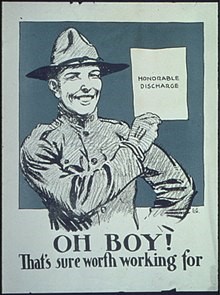

World War I poster depicting a soldier holding his honorable discharge.
Honorable[edit]
To receive an honorable discharge, a service member must have received a rating from good to excellent for their service. Service members who meet or exceed the required standards of duty performance and personal conduct, and who complete their tours of duty, normally receive honorable discharges. However, one need not complete a term of service to receive an honorable discharge, provided the reason for involuntary discharge is not due to misconduct. For instance, service members rendered physically or psychologically incapable of performing assigned duties normally have their service characterized as honorable, regardless of whether they incurred the condition or disability in the line of duty, provided they otherwise met or exceeded standards. Similarly, service members selected for involuntary discharge due to a Reduction in Force (RIF) typically receive an honorable discharge, assuming their conduct while on active duty met or exceeded standards. Individuals with honorable discharges may, under certain circumstances, be allowed to re-enter military service.
AR 635-200, para 9–4. “Characterization of service or description of separation The service of Soldiers discharged under this section will be characterized as honorable or under honorable conditions unless the Soldier is in entry-level status and an uncharacterized description of service is required. An honorable discharge is mandated in any case in which the Government initially introduces into the final discharge process limited use evidence as defined by AR 600–85, paragraph 6–4. (See para 2–6h for procedures for reinitiation or rehearing, if appropriate.)”[18]
General[edit]
General discharges are given to service members whose performance is satisfactory but is marked by a slight departure in duty performance and conduct expected of military members. Reasons for such a characterization of service vary, from medical discharges to misconduct, and are utilized by the unit commander as a means to correct unacceptable behavior prior to initiating discharge action (unless the reason is drug abuse, in which case discharge is mandatory). A commander must disclose the reasons for the discharge action in writing to the service member, and must explain reasons for recommending the service be characterized as General (Under Honorable Conditions). The service member is normally required to sign a statement acknowledging receipt and understanding of the notification of pending discharge memorandum. The person is also advised of the right to seek counsel and present supporting statements.
In addition, service members are required to sign documents acknowledging that “substantial prejudice in civilian life” may be encountered under a general discharge.[19] A general discharge may or may not preclude a veteran’s participation in the GI Bill, service on veterans’ commissions, and other programs for which an honorable discharge is required, but is eligible for VA disability and most other benefits.[20] Illinois prohibits discrimination against a veteran from housing or employment on the basis of unfavorable discharge from military service per the Human Rights Act of 1970.[21] This Illinois protection does not apply to lower types of discharge.
Other Than Honorable (OTH)[edit]
An Other Than Honorable Discharge represents a significant departure from the conduct and performance expected of all military members.
Generally, in order to receive VA benefits and services, the veteran’s character of discharge or service must be under “other than dishonorable” conditions (i.e., honorable, under honorable conditions, or general) as stated by law (Title 38, United States Code). However, individuals receiving an other-than-honorable or bad conduct discharge will have their service reviewed and if certain statutory and regulatory bars do not apply they will be allowed access to VA benefits and services. See 32 C.F.R. 3.12. The VA adjudication of a person’s service characterization, including examination of these bars, is called a “Character of Discharge” (COD) review (sometimes referred to as a “Character of Service Determination (CSD)”), as defined by 38 USC 5305B.
Veterans with an OTH discharge and considered Honorable for VA purposes may apply for the full enrollment in the VA. Assuming other eligibility criteria are met, they will receive the medical package, disability benefits, vocational programs, and other wrap-around services. Once the VA has deemed an OTH “Honorable for VA Purposes” it is similar to having a General discharge in terms of benefits and services.
Veterans must have an Honorable discharge from the Department of Defense in order to use the GI Bill. “Honorable for VA Purposes” is not the same and does not qualify for education benefits. However, even if someone has a less-than-fully honorable discharge, they may have other periods of service that qualify them for the education benefits.
Veterans with Other Than Honorable discharges who are deemed “Dishonorable for VA Purposes” because of a regulatory bar may still qualify for health care for a service-connected condition or injury only. If the veteran is barred due to a statutory condition, this limited health care is not available.
(Veterans with a Bad Conduct Discharge will not be eligible for health care, even with a positive Character of Discharge review; they will only be eligible for disability benefits. They are barred by statute from receiving VA health care. Further, veterans with a Bad Conduct Discharge received by a general court-martial are not eligible for a COD review.)
Clemency Discharge[edit]
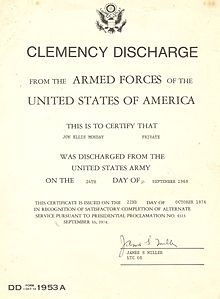

Clemency Discharge established by Presidential Proclamation 4313
By Presidential Proclamation 4313,[22] President Gerald Ford created a procedure for those military personnel who resisted the Vietnam War to receive a Presidential Pardon and have their punitive discharges changed to a Clemency Discharge. It also provided a path for those who left the country to return. If the military personnel fulfilled certain requirements of alternative service, they would also receive a Certificate of Completion from the Selective Service System.
Punitive discharges[edit]
Punitive discharges constitute conduct prejudicial to good order and discipline.
Bad Conduct Discharge (BCD)[edit]
“Big chicken dinner” redirects here. For actual chicken dinners, see Chicken as food.
A Bad Conduct Discharge (BCD), colloquially referred to as a”big chicken dinner”, from the initialism,[23] can only be given by a court-martial (either special or general) as a punishment for an enlisted service member. Bad conduct discharges are often preceded by a period of confinement in a military prison. The discharge itself is not executed until completion of both confinement and the appellate review process.
Virtually all veterans’ benefits are forfeited by a Bad Conduct Discharge; BCD recipients are not eligible for VA disability compensation unless they were discharged via special court-martial and the VA determines that their service was “Honorable for VA Purposes” in accordance with 38 CFR 3.12. Even then, these veterans are barred from health care by law.
Dishonorable[edit]
A dishonorable discharge (DD) can only be handed down to a military member by a general court-martial. Dishonorable discharges are handed down for what the military considers the most reprehensible conduct. This type of discharge may be rendered only by conviction at a general court-martial for very serious offenses (e.g., treason, espionage, desertion, sexual assault, murder) that call for dishonorable discharge as part of the sentence.
With this characterization of service, all veterans’ benefits are lost, regardless of any past honorable service, and this type of discharge is regarded as shameful in the military. In many states a dishonorable discharge is deemed the equivalent of a felony conviction, with attendant loss of civil rights. In some states, those who have been dishonourably discharged may also be barred from voting, holding office or doing jury service because they were discharged as the result of a felony conviction.[24] Additionally, US federal law prohibits possession of firearms or ammunition by those who have been dishonorably discharged[25] per the Gun Control Act of 1968, and being dishonorably discharged is as well a disqualifying question on the Form 4473, which must be completed and signed to purchase a firearm from a Federal Firearms Licensee (FFL) and will result in a denial by the Brady background check that must be performed and passed to allow a sale.
Statistics[edit]
According to the Department of Defense, of 207,000 service members that were discharged in 2014, more than 18,000 (9%) were issued less-than-honorable paperwork, including 4,143 (2.0%) other-than-honorable discharges, 637 (0.31%) bad conduct discharges, and 157 (0.08%) dishonorable discharges. Between 2000 and 2014, 352,000 people in all were handed similar papers, ranging from general discharge to bad conduct and dishonorable discharge.[26]
Analogous proceedings for commissioned officers[edit]
Commissioned officers cannot be reduced in rank by a court-martial, nor can they be given a bad conduct discharge or a dishonorable discharge. If an officer is convicted by a general court-martial, then that officer’s sentence can include a “dismissal”, a separation carrying the same consequences as a dishonorable discharge for an enlisted person and a reduction in rank to the last rank at which the officer served satisfactorily. A US Treasury decision states that even though an officer is dismissed rather than dishonorably discharged, the phrase “discharged from the Armed Forces under dishonorable conditions” is broad enough to include a dismissal rendered for an officer by a general court-martial, and thus a dismissed officer is also prohibited from possessing firearms or ammunition under federal law, in the same manner as a dishonorably discharged enlisted person.[27][verification needed]
If a court-martial convicts an officer but imposes a sentence that does not include a dismissal, the secretary of the officer’s service branch may drop that officer from the roll (official list) of officers in that branch. Such a separation is characterized as administrative rather than punitive.[28]
Appeal procedures[edit]
After discharge, a service member (or their next-of-kin, if the service member is deceased) can appeal the type of discharge that was given.
The member must file form DD-293 if discharged within 15 years, or form DD-149 if over 15 years ago. The forms are significantly different and go to the Discharge Review Board (DRB) and the Board for correction of military records (BCMR) respectively.[citation needed] 10 U.S.C. §§ 1552–1553 provide the law for this action.
The service member (or their next of kin if the service member is deceased) must submit evidence for error, impropriety or inequity in discharge. Most requests are rejected,[29] with a change authorized only if it can be proven the service member was unfairly denied an honorable characterization.
Appellate review of punitive discharges[edit]
Any punitive discharge adjudged by a Court-Martial is automatically reviewed by a military appellate court for each respective branch. These are the Army Court of Criminal Appeals (ACCA), Air Force Court of Criminal Appeals (AFCCA), Navy-Marine Corps Court of Criminal Appeals (NMCCCA), and the Coast Guard Court of Criminal Appeals (CGCCA). These courts are staffed by appellate military judges and function as an intermediate appellate court and have the power to review de novo both any questions of legal error and the factual basis of the conviction. If either the government or the accused is dissatisfied with the results of this appeal, the conviction or the sentence can be appealed to the Court of Appeals for the Armed Forces (CAAF). This court has the power of discretionary review, in that it can in some cases deny a petition to grant a review. This court however must hear any death penalty cases or cases certified by the Judge Advocate General of each respective service for appellate review. Litigants before the CAAF can appeal to the United States Supreme Court. However, this right only applies to any case that the CAAF has reviewed. Therefore, in most military justice cases, the CAAF is the court of last resort since a denial of a petition of review by that court prevents higher appeal.
Servicemembers who are given a punitive discharge and have completed any adjudged confinement are normally placed on appellate leave pending final review of their cases by the appellate courts. This includes members who plead guilty at their courts-martial since all cases are automatically reviewed. The member is considered on active duty and is subject to the Uniform Code of Military Justice while on appellate leave. While the member is entitled to full health care benefits and other privileges of being on active duty, the member receives no pay or allowances and is relieved of any military duties.
A service member who was adjudged a punitive discharge at a court martial and then dies before the appellate review process is complete is considered to have died on active duty under honorable conditions. Their next-of-kin is then entitled to any rights and benefits to which any other service member’s family would be entitled.
Upgrade of administrative discharges and special court-martial BCDs[edit]
Once discharge is finalized, General, Entry-Level/Uncharacterized, and Under Other Than Honorable Conditions (UOTHC or OTH) discharges may be appealed for upgrade through the Discharge Review Board of the respective service; however, the appeal must be filed within 15 years of the date of separation, and it must be shown that the characterization of service was the result of an error or injustice. Bad Conduct Discharges handed down by a Special Court-Martial may be upgraded only as an act of clemency. Discharge Review Boards may also consider appeals for a change to the Narrative Reason for Discharge (in Block 28 of DD 214). The DRB does not consider a request for the change of a Reenlistment Eligibility (RE) or Separation Designator (SPD) Code by itself, but they are often changed to correspond with the new characterization of service and/or narrative reason for discharge if a discharge is upgraded.
If more than 15 years have passed since discharge, appeals must be directed to the Board For Correction of Military/Naval Records of the respective service. The BCM/NR hears a wide array of appeals and correction requests, and can be utilized by Active Duty, Reserve, National Guard, retired and discharged veterans alike. Normally, an appeal must be filed within three years of the occurrence of an error or injustice; however, exceptions are often made.
In the United States, every service member who is discharged or released from active duty is issued a DD Form 214 and a military discharge certificate (denoting the discharge type, such as Honorable). A reservist who is called to active duty is given a DD 214 when he or she is deactivated and returned to the reserves. Those who are discharged before completing 8 years of active duty or reserve duty in an active drilling status are transferred to the Individual Ready Reserve (IRR) for the remainder of their military service obligations (MSO). The Individual Ready Reserve does not drill or receive pay; however, a member in IRR status can be recalled to active duty during time of war or national emergency until the 8 years have expired. Most members separating with an honorable discharge after completing a single term of service (typically 3–6 years) are transferred to the IRR for the remainder of the 8-year MSO. Retirees are furnished with the DD 214, though a U.S. military retirement is not characterized as a discharge as retirees may be recalled to active duty, under certain circumstances, until they have achieved a total of 30 years of service.
The DD 214 is a complete documentation of military service. It contains everything from total time in service, dates of entry and discharge, dates of rank, documentation of foreign service, ribbons, medals and badges awarded, professional military education completed, characterization of service, and reason for discharge (among other things). In responses to job applications, many employers request a copy of the DD 214. There are two DD 214 types: the edited (or “short”) version, and the unedited (or “long”) version. The edited version omits certain information, including the reason for discharge.
Employers often request the unedited version, but the legality of this is debatable in certain situations. It can be denied, especially if the “long” version references facts that violate the right to privacy or could be used in a discriminatory fashion (such as non-relevant psychological, medical, or disability issues) explicitly cited as illegal by federal or state hiring laws. For example, the Illinois Human Rights Act prohibits discrimination due to unfavorable discharge. A service member may request the edited, unedited, or both versions on separation.
Since the 1970s, an honorably discharged veteran receives a frameable certificate (DD 256). A similar one is issued to someone granted a general discharge (DD 257). For each certificate, one or more letters after the number indicate the branch of service that issued it. For example, a “256A” is awarded by the Army. Other certificates for long service, or to eligible spouses of veterans, may also be presented.[30]
The Freedom of Information Act has made (limited) records of military service available to the public, on request. However, information protected by the Privacy Act of 1974 can be released only with the veteran’s consent.
Military discharge uniform insignia[edit]
During wartime the American military have often issued special insignia to honorably discharged veterans to wear on their uniforms to distinguish them from local service personnel or deserters.
The Army issued red Discharge Chevrons during and after World War One (1917–1919) that were worn point-up on the lower right sleeve of the tunic or overcoat. Just before and just after World War Two (September 1939 – December 1946) the Army issued the Honorable Discharge Insignia (or “Ruptured Duck”). It was an eagle in a circle badge sewn in yellow thread on an olive drab diamond that was worn over the right breast pocket on the “Class A” dress tunic.
The Marine Corps issued an Honorable Discharge Lapel Button from 1916 to the present that was meant to be worn with civilian clothes. During World War II from 1941 to 1945 a contrasting diamond worn on the lower right sleeve with the Dress Blues or Dress Whites (a white diamond on the Dress Blues and a blue diamond on the Dress Whites) by retired Marines. A white diamond was worn on the upper right shoulder (like a Distinctive Unit Insignia) on the Service Green or Service Khaki “Alphas” and the overcoat by discharged Marines.
In 1945 the Navy and Marine Corps adopted the Army’s “Ruptured Duck” insignia to handle the large number of discharged service people at the end of the war.[citation needed]
Reenlistment Eligibility Code[edit]
Another important aspect is the RE (Reenlistment Eligibility) Code. This specifies under what conditions the member can reenlist in the armed forces. The definition of each RE Code may vary from Service to Service, as currently it is the responsibility of each branch of the Armed Forces to establish reenlistment eligibility criteria. As a general rule, however, an RE Code in the “1” series allows reenlistment into any component of the Armed Forces, and an RE Code in the “3” series usually lets the veteran reenlist with a waiver. RE Codes in the “2” series often place restrictions on reenlistment: this is especially true in the Air Force, which has a policy permanently barring airmen separated from the Air Force with an RE Code 2 from reenlisting in the Air Force (though reenlistment into other components of the Armed Forces may be possible with a waiver). An RE Code in the “4” series typically bars reenlistment into any component of the Armed Forces. (It is possible for a person with an RE Code of 4 to enlist in the Navy or Air Force if the SPD Code and the Narrative Reasoning is waivable.) A veteran issued an RE Code in the “4” series usually requires an Exception to Policy waiver to reenlist.
The Department of Veterans Affairs uses different criteria from the Departments of the Air Force, Army, and Navy when establishing veteran status. VA benefits can sometimes be enjoyed if the veteran’s service was under “other than dishonorable” conditions. An example of this would be the VA’s health care and home loan programs.[31]
Presidential Proclamation
Click on the link above to read this proclamation:
Proclamation 4313—Announcing a Program for the Return of Vietnam Era Draft Evaders and Military Deserters
September 16, 1974
Now, Therefore, I, Gerald R. Ford, President of the United States, pursuant to my powers under Article II, Sections 1, 2 and 3 of the Constitution, do hereby proclaim a program to commence immediately to afford reconciliation to Vietnam era draft evaders and military deserters upon the following terms and conditions:
DD Form 214
https://en.wikipedia.org/wiki/DD_Form_214
The DD Form 214, Certificate of Release or Discharge from Active Duty, generally referred to as a “DD 214“, is a document of the United States Department of Defense, issued upon a military service member’s retirement, separation, or discharge from active duty in the Armed Forces of the United States, e.g., U.S. Army, U.S. Navy, U.S. Marine Corps, U.S. Air Force, U.S. Space Force, and the U.S. Coast Guard.
History and usage[edit]
The first DD Form 214s were issued in 1950, replacing the older “WD AGO” (War Department Adjutant General’s Office) Forms and the NAVPERS (Naval Personnel) discharge documents. These documents had existed since 1941. In earlier versions of the form (1 November 1972) it was called a “Report of Separation from Active Duty”; the current title dates from 1 July 1979.
DD Form 214 is the capstone military service document, as it represents the complete, verified record of a service member’s time in the military (Active and Reserve), awards and medals, and other pertinent service information, such as highest rank/rate and pay grade held on active duty, total military combat service or overseas service, Military Occupational Specialty (MOS), Air Force Specialty Code (AFSC) or Navy officer designator, Navy Officer Billet Code (NOBC), Additional Qualification Designation (ACD) or Navy Enlisted Classification (NEC) identifiers and a record of training and schools completed. Individuals who served exclusively in the Air National Guard or Army National Guard do not receive a DD Form 214, but will receive a form called NGB-22 from the National Guard Bureau.
The DD Form 214 is commonly used by various government agencies, chief among them the Department of Veterans Affairs, to secure veteran benefits, and may be requested by employers should a person indicate he or she has served in the military.
This document also contains codes used by the Armed Forces to describe a former servicemember’s reason for discharge and, in the case of enlisted personnel, their reenlistment eligibility. These codes are known as Separation Designator/Separation Justification (abbreviated as SPD/SJC) Codes and Reenlistment Eligibility (RE) Codes, respectively.
DD Form 214 is also generally required by funeral directors in order to immediately prove eligibility for interment in a VA cemetery, to obtain a grave marker or to provide military honors to a deceased veteran. On September 1, 2000, the National Defense Authorization Act enabled, upon the family’s request, every eligible veteran to receive a military funeral honors ceremony to include the folding and presentation of the United States burial flag and the sounding of Taps at no cost to the family.
Copies of DD Form 214s are typically maintained by the government as part of a service member’s 201 file or OMPF (Official Military Personnel File). The 201 file generally contains additional personnel related forms.
Available versions[edit]
There are two versions of the DD Form 214, usually referred to simply as “short” or “redacted” or “deleted” (edited), and “long” or “unredacted” or “undeleted” (unedited) copies. The edited, or “short”, copy omits a great deal of information, chiefly the Characterization of Service, Reason for Separation, and Authority for Separation.[1][2]
Copies[edit]
Service members are given the option of accepting the “short form” edited Member 1, “long form” unedited Member 4 or both copies upon separation.
The most important copy of the DD 214 for the individual is the long form copy. It is the standard form needed to obtain benefits such as GI Bill or government employment priority.
There are eight original DD214 copies. All but Member 1, the “short form” copy, contain information as to the nature and type of discharge, and the re-enlistment code. This code is used to determine whether or not the service member can go back into the service. For unemployment benefits, veterans affairs benefits, as well as for several other services, the “Member’s Copy 4” is usually requested but any other “long form” copy is acceptable. All eight copies are identical except Member 1, the “short form,” which lacks this critical information. The military will not provide a replacement “Member’s Copy 4” (it is the service member’s personal copy and physically given to him at separation) and any request for a replacement is always honored by providing a “Service 2”, “Service 7” or “Service 8” copy. All but Member 1 are acceptable legal substitutes for Member 4.
Other versions of the DD Form 214 include the “Member 1” (deleted version), “Service 7 & 8” (additional copies of the “Service 2”), “Veterans Affairs 3” (sent directly to the Department of Veterans Affairs), “Member 6” (provided to the respective veteran’s State Department of Veteran Affairs), and “Department of Labor 5” (provided directly to the United States Department of Labor).
If for whatever reason an original DD214 is unusable, unreadable, or destroyed, upon verification of service, the National Personnel Record Center can issue NA Form 13038, a Certification of Military Service, which is also a perfect legal substitute for DD214.
Electronic Cost-Free Copy of DD 214[edit]
eBenefits, a web portal[3] managed jointly by the United States Department of Veterans Affairs (VA) and the United States Department of Defense (DoD) provides Service members with free electronic copies of their Official Military Personnel File, including their DD Form 214. Electronic copies will be provided within 48 hours from the time of request. In order for a service member to request a DD 214 in eBenefits, they must have an eBenefits Premium Account ( DS Logon Level 2[4]).
Paper Cost-Free Copy of DD 214[edit]
The National Personnel Records Center is the government agency tasked with replacing lost and destroyed DD Form 214s upon request from a veteran. Requested copies are mailed from the Military Personnel Records Center. Most veterans who separated from their service generally pre-1992 can obtain their DD 214 from the National Personnel Records Center, (“NPRC”). The NPRC has two distinct tracks available to obtain records for veterans. The first is for the veteran to submit a Department of Defense Standard Form 180 (“SF180”) to the facility via mail or fax. The second is to appear in-person at the facility. The National Archives also maintains a list of independent researchers who will physically visit the St. Louis facility to request records in person.[5]
Corrections[edit]
The DD Form 215 (“Correction to DD Form 214, Certificate of Release or Discharge from Active Duty”) is used to correct errors or additions to a DD Form 214 discovered after the original had been delivered or distribution had been made. It is distributed in the same manner as the DD Form 214.
Distribution[edit]
A DD Form 214/215 is prepared in eight copies and distributed as follows:
- Copy 1 – Service Member
- Copy 2 – Service Personnel File
- Copy 3 – United States Department of Veterans Affairs
- Copy 4 – Member (if initialed in Block 30)
- Copy 5 – United States Department of Labor
- Copy 6 – State Director of Veteran Affairs
- Copy 7 & 8 – Distributed in accordance with Military Service Department directions (shredded and retain)
See also[edit]
References[edit]
- History, Usage and
Acquisition of DD214s
- ^ Northwest Justice Project. “Sample DD 214”. RepWaVets.org (Representing Washington Veterans). Archived from the original on February 20, 2018. Retrieved February 20, 2018.
- ^ DD214.TLD. “Your DD214 and Veterans’ Employment Opportunities: DD214 and Jobs”. DD214.us. Retrieved February 20, 2018.
- ^ eBenefits Site Tour. YouTube. 17 October 2012.
- ^ How to Get a DS Logon for eBenefits. YouTube. 9 May 2014.
- ^ How To Acquire Your DD214, Military Separation Records. YouTube. 12 May 2014.
What does a DD 214 look like and why is it so important?
Click on the link below
https://dd214direct.com/dd214-look-like-important/
To see examples of multiple DD 214s click on the following link:
Another Page Explaining DD- 214 and its importance
Separation Codes found on DD 214 and other documents
http://www.dd214.us/reference/SPN_Codes.pdf
List of most D of D forms (Click on Link below)
https://www.esd.whs.mil/Directives/forms/dd0001_0499/
What does a soldier get paid?
Click on the link below
https://en.wikipedia.org/wiki/Military_compensation
Types of Military Discharges Explained
Click on the link Below
https://militarybenefits.info/types-of-military-discharges-2/
Orders, General Orders, Special Orders, Bulletins and Circulars Explained
Click on link below
The following link is a WWII pamphlet associated with the link above describing order, etc.
(Click on the link below)
https://digitalcommons.unl.edu/cgi/viewcontent.cgi?article=1007&context=usarmytrain
The following link will take you to Fold 3 and the general orders of the Confederate War Department.
https://www.fold3.com/title/852/general-orders-of-confederate-war-dept/description
Charles F McKiever Military Timeline
Tips for advanced research on Fold 3
Complete List of Discharge Documents
https://www.va.gov/records/discharge-documents/
https://www.cem.va.gov/hmm/discharge_documents.asp
https://www.milvets.nc.gov/media/6/open
https://www.disasterassistance.gov/get-assistance/forms-of-assistance/4709
Walt Disney- https://www.snopes.com/fact-check/dishonorable-discharge/
WWI Discharge and other Chevrons and insignias
https://portraitofwar.com/tag/1918/
https://www.usmilitariaforum.com/forums/index.php?/topic/211468-the-ww-i-discharge-chevron/
https://members.tripod.com/~Fbg_mem_museum/uniftalk/unipat3.htm
WWII
Ruptured Duck: https://www.flickr.com/photos/strandarchives/6866130329
https://www.flickr.com/photos/strandarchives/with/6866130329/
https://en.wikipedia.org/wiki/Honorable_Service_Lapel_Button
Korea- Viet Nam
http://www.amervets.com/warlib6/warlib6v.htm
http://www.amervets.com/warlib6/warlib6k.htm
https://www.usmcu.edu/Portals/218/ranks%20and%20grades%201775-1969.pdf