City Directories
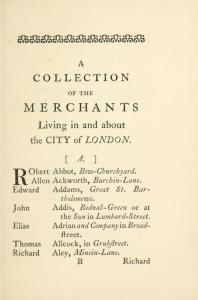
The earliest known City Directory, The Companyes of all the Craftes or Mysteries of London was published in London as a manuscript compiled by the Treasury of the Receipt of the Exchequer, in 1588.
The “first” printed directory-type listing of inhabitants of an American city”, was a broadside listing of English families in Baltimore, Maryland published in 1752 titled The Following List of Families and Other Persons Residing in the Town of Baltimore, Was Taken in the Year 1752, by a Lady of Respectability.
Why were Directories Created
Directories were created for salesmen, merchants, and other interested in contacting residents and businesses of an area. They are arranged alphabetically giving lists of names and addresses, telephone numbers and in more modern times, websites of businesses and usually, also, adult residents of a city or area.
The most helpful directories for genealogical research are city and county directories of local residents and businesses. These are generally published annually and may include an individual’s address, occupation, spouse’s name, and other helpful facts. An individual’s address can be very helpful when searching an unindexed census of a large city.
In more recent years print city directories have become obsolete and but have now moved online to digital formats.
Why Use Directories
- Directories are particularly helpful for research in large cities, where a high percentage of the people were renters, new arrivals, or temporary residents.
- A directory may be the only source to list an ancestor if he or she was not registered to vote and did not own property.
- Learn the exact years your ancestor inhabited a place.
- Locate ancestor in a census that hasn’t been indexed (esp. state census).
- Estimate year of immigration.
- Learn occupation and employer as identifiers
- Find other family members.
Potential Content
- An alphabetical listing of inhabitants (arranged by name, address, and occupation).
- A street address listing (arranged by address, name, and occupation).
- Widows, working women, and adult children at home.
- Ward maps.
- Street locator, including cross streets.
- Street name changes.
- Removals (sometimes destinations!).
- Businesses (and index to advertisers).
- Addresses and maps of churches, schools, funeral homes, cemeteries, post offices, courts, hospitals, benevolent associations, newspapers.
- Many early directories listed only businesspeople.
- Some directories list wife in parenthesis.
- Whether a woman is a widow (including name of husband).
- List of marriages and deaths of previous year.
- Sometimes a date of death.
The Family History Library has a comprehensive collection, City Directories of the United States, reproduced on microform by Research Publications. This includes 336 cities and regions from the late 1700s to 1935. The pre-1860 city directories are on more than 6,000 microfiche. Directories for 1861 to 1935 are on 1,118 microfilms. These and other directories are listed in the Place Search of the FamilySearch Catalog under
[STATE], [COUNTY], [TOWN] – DIRECTORIES FamilySearch Catalog U.S. City Directories, 1795-1860 Microfiche 6013501-6044684
You can find further information about city directories in FamilySearch Wiki pages regarding each state. For example, search Ohio directories for information about directories of Ohio.
Some directories list only certain types of businesses, professionals, clergymen, alumni, or other special groups. These are listed in the Place Search of the FamilySearch Catalog under:
[STATE] – DIRECTORIES
[STATE] – OCCUPATIONS
[STATE], [COUNTY] – DIRECTORIES
[STATE], [COUNTY] – OCCUPATIONS
There are also special directories that can help you locate libraries, newspapers, churches, ethnic associations, government officials, and other organizations or offices.
Here is a list of some of the typical informational categories as found in the 1901-1902 Galveston, Texas City Directory:
US Congressmen
US Court
US Officials
US Senators and Representatives
US Weather Bureau
TX State Courts
TX Supreme Court
Tx Senators and Reprentatives
County Officials
Street Directory
Fire Alarm Boxes
Foreign Consuls
Charitable institutions
Post Offices of Texas with County
Builders Exchange
Rolls of members and Occupation
Clubs with membership
Date of organization
Labor organizations
Library
Fraternal Organizations
Military
Newspapers
Musical Organizations
Steamship Lines
Streetcars
Temperance Organizations
Rail Distances from Galveston
Listed by Rail Line
Church Directory including dates and times of service and preachers
Church Societies
Schools-Value of school property
Number of students
Courses taught
Teacher’s names with the subject they taught
Principals
Colored Schools
Private Schools
Publishing is all about Advertising- Advertising is Money
There were discounts- the more a businessman bought the more he saved
Payments usually a percentage down and the remaining in monthly payments
Bigger discounts for full payment up front
Every part of every page of a Yellow Page Directory was/is for sale:
Each person got a free listing in the white pages
Every business (with a business telephone line) got a free listing in the white pages and in the category of their business type
Chargeable items were:
Extra listings in any other or as many category as the business the owner wished
Bold Print, colored print, italics or other fonts, logos or icons
Classified/ Box type advertising in a stock type format or by the column inch
Covers-Front, back, inside front, inside back, inserted pages, in column edges
Full page, half page, quarter page, eight page, etc with pictures and text
When color and photographs were introduced in directories charges for those services could be purchased
Aside from the advertising, business people would purchase copies of the directories. Many businesses maintained annual subscriptions
Directories by State-See the FH Wiki for a link to each State
Directories online:
Cyndislist.com https://cyndislist.com/directories/
Cyndislist.com US Specific https://cyndislist.com/directories/us/
Family Search https://www.familysearch.org/search/collection/3754697
Don’s List (free) http://www.donslist.net/PGHLookups/DirM.htm
Ancestry $- Free at some libraries and family history centers https://www.ancestry.com/search/collections/2469/
My Heritage $ Free at some libraries and family history centers
Ancestry Search Tips https://www.ancestry.com/search/categories/dir_city/?_ga=2.113451015.1667575662.1620020459-1262424635.1620020459
Fold3 $ Free at some libraries and family history centers
Findmypast $
US City Directories http://www.uscitydirectories.com/
Dallas Public Library 7th Floor (not digitized-mainly Texas) Dallaslibrary.org
Access Genealogy https://accessgenealogy.com/new-jersey/some-essex-county-new-jersey-city-directories.htm
Portals of Texas History- City Directories https://texashistory.unt.edu/explore/collections/CIT/
Wikipedia https://en.wikipedia.org/wiki/City_directory
History of Information https://www.historyofinformation.com/image.php?id=4150
History of NYC City Directories https://www.nypl.org/blog/2012/06/08/direct-me-1786-history-city-directories-US-NYC
How to Use City Directories https://lisalisson.com/how-to-use-city-directories-in-your-genealogy-research/
City Directories at Myheritage.com https://blog.myheritage.com/2020/02/myheritage-adds-huge-collection-of-historical-u-s-city-directories/
Family Tree Magazine House History Case History (Premium article) https://www.familytreemagazine.com/house-history/house-history-research-example/
Family Search on City Directories https://www.familysearch.org/wiki/en/United_States_Directories
Telephone Directories

The first telephone directory, consisting of a single piece of cardboard, was issued on 21 February 1878 in New Haven, CT. It listed of 11 individuals, 38 businesses, and the police department. It was not alphabetized nor did it list the telephone numbers of those listed in it.
In 1879, Dr. Moses Greeley Parker suggested the format of the telephone directory be changed so that subscribers appeared in alphabetical order and each telephone be identified with a number. Dr. Parker came to this idea out of fear that Lowell, Massachusetts‘s four operators would contract measles and be unable to connect telephone subscribers to one another.
The first British telephone directory was published on 15 January 1880 by The Telephone Company. It contained 248 names and addresses of individuals and businesses in London; telephone numbers were not used at the time as subscribers were asked for by name at the exchange.
The Reuben H. Donnelly company published the first classified directory, or yellow pages, for Chicago, Illinois, in 1886.
In 1981, France was the first country to have an electronic directoryon a system called Minitel. The directory is called “11” after its telephone access number.
In 1991, the U.S. Supreme Court ruled (in Feist v. Rural) that telephone companies do not have a copyright on telephone listings, because copyright protects creativity and not the mere labor of collecting existing information.
In 1996, the first telephone directories went online in the USA. Yellowpages.com and Whitepages.com both saw their start in April. In 1999, the first online telephone directories and people-finding sites such as LookupUK.com went online in the UK. In 2003, more advanced UK searching including Electoral Roll became available on LocateFirst.com.
Types of Telephone Book Pages
A telephone directory and its content may be known by the colour of the paper it is printed on.
- White pages generally indicates personal or alphabetic listings.
- Yellow pages, golden pages, A2Z, or classified directory is usually a “business directory”, where businesses are listed alphabetically within each of many classifications (e.g., “lawyers”), almost always with paid advertising.
- Grey pages, sometimes called a “reverse telephone directory”, allowing subscriber details to be found for a given number. Not available in all jurisdictions. (These listings are often published separately, in a city directory, or under another name, for a price, and made available to commercial and government agencies.)
Other colors may have other meanings; for example, information on government agencies is often printed on blue pages or green pages.
Telephone companies pay cities for contracts to own, create and maintain telephone lines and the infrastructure and service over those lines. As a part of their contract telephone companies were required to publish up to date and accurate telephone numbers and addresses of the listings of person or business purchasing their service. Current status of this law is unknown by Mic.
How to Find Old Telephone Directories as described by Techwalla at https://www.techwalla.com/articles/how-to-find-old-telephone-directories
- Check your local library. Check your local library to see if it houses old phone directories. …
- Library of Congress. …
- Call a phone company. …
- Contact the Telecommunications History Group. …
- Look online.
Spyralsearch has telephone directories from the 1920’s to the 1990’s https://www.spyralsearchsales.com/index.html
National Archives has several links to sources:
https://www.archives.gov/research/alic/reference/mail-and-telephone-directories.html
Telephone Directories at the Library Of Congress
The Library of Congress’s collection of telephone directories represents the following states and localities: Alabama, Alaska, Arizona, Arkansas, California, Colorado, Connecticut, Delaware, the District of Columbia, Florida, Georgia, Hawaii, Iowa, Maryland, Pennsylvania, and the city of Chicago. The dates of the directories span most of the 20th century. The Library’s United States telephone directory collection consists of 8,327 digitized reels of microfilm; of these, about 3,500 are presented in this collection. The remainder of the collection may be requested from the Microform Reader Services (LJ 139).
Every part of every page of a Yellow Page Directory was/is for sale:
Each person got a free listing in the white pages
Every business (with a business telephone line) got a free listing in the white pages and in the category of their business type
Chargeable items were:
Extra listings in any other or as many as the business the owner wished
Bold Print, colored print, italics or other font
Covers-Front, back, inside front, inside back, inserted pages
Box type advertising in a stock type format or by the column inch
Full page, half page, quarter page, eight page, etc with pictures and text
When color introduced in directories charges for color could be purchased
Bibliography
Telephone Books
Mobile Cell Phone Online Book http://www.mobilephoneno.com/#:~:text=MobilePhoneNumber.com%20provides%20a%20free,address%20and%20even%20job%20title.&text=MobilePhoneNumber.com%20provides%20a%20free,address%20and%20even%20job%20title.
Texas Administrative Code: Regulations regarding telephones and telephone listings https://texreg.sos.state.tx.us/public/readtac$ext.TacPage?sl=R&app=9&p_dir=&p_rloc=&p_tloc=&p_ploc=&pg=1&p_tac=&ti=16&pt=2&ch=26&rl=128
Wikipedia-Telephone Directory
The Book of Numbers: A History of the Telephone Book (Saturday Evening Post February 2010)
https://www.saturdayeveningpost.com/2010/02/book-numbers/
Sixty Million Headaches a Year
http://www.saturdayeveningpost.com/wp-content/uploads/satevepost/sixty_million_headaches.pdf
The Book of the Undead: Why Won’t Telephone Books Die?
https://slate.com/culture/2008/03/why-won-t-phone-books-die.html
Wikipedia- Yellow Pages https://en.wikipedia.org/wiki/Yellow_pages
Yellow Pages United .com https://www.yellowpagesunited.co/the-yellow-pages-walking-fingers-the-most-famous-symbol-never-trademarked/
Bell Buys Mast Yellow Pages
Library of Congress Collection: https://www.loc.gov/collections/united-states-telephone-directory-collection/about-this-collection/